
From Scaling Bottlenecks to Seamless IT/OT Convergence

Inter-VLAN Routing
Achieves high-speed data transfer between different network segments through L3 switching
Static Routing
Manually defines precise optimal forwarding paths, ideal for stable network environments
Unicast Routing
Supports dynamic routing protocols such as OSPF and RIP to automatically learn optimal paths
Multicast Routing
Optimizes one-to-many transmission for video streaming and control signals
In the early days of industrial networking, Layer 2 switches were the standard, functioning primarily as transparent bridges within a single local area network. However, as Industrial Internet of Things (IIoT) architectures expanded, the sheer volume of connected devices created significant operational hurdles. The most pressing issue was the broadcast storm. In a flat Layer 2 environment, broadcast traffic like Address Resolution Protocol (ARP) requests is flooded to every single port. As the node count grew, these broadcasts consumed massive amounts of bandwidth, leading to network congestion and even complete system crashes.
Furthermore, these massive flat networks suffered from a lack of segmentation. Without logical boundaries, a security breach or a simple hardware malfunction in one sector of the factory could propagate instantly across the entire enterprise. This "all-or-nothing" connectivity made it impossible to isolate critical control traffic from non-essential data. Additionally, managing thousands of MAC addresses on a single segment became a latency nightmare. Traditional routers were too slow and lacked the ruggedization required for the plant floor, creating a bottleneck between the shop floor and the corporate office that the existing hardware simply couldn't bridge efficiently.

Our Solution
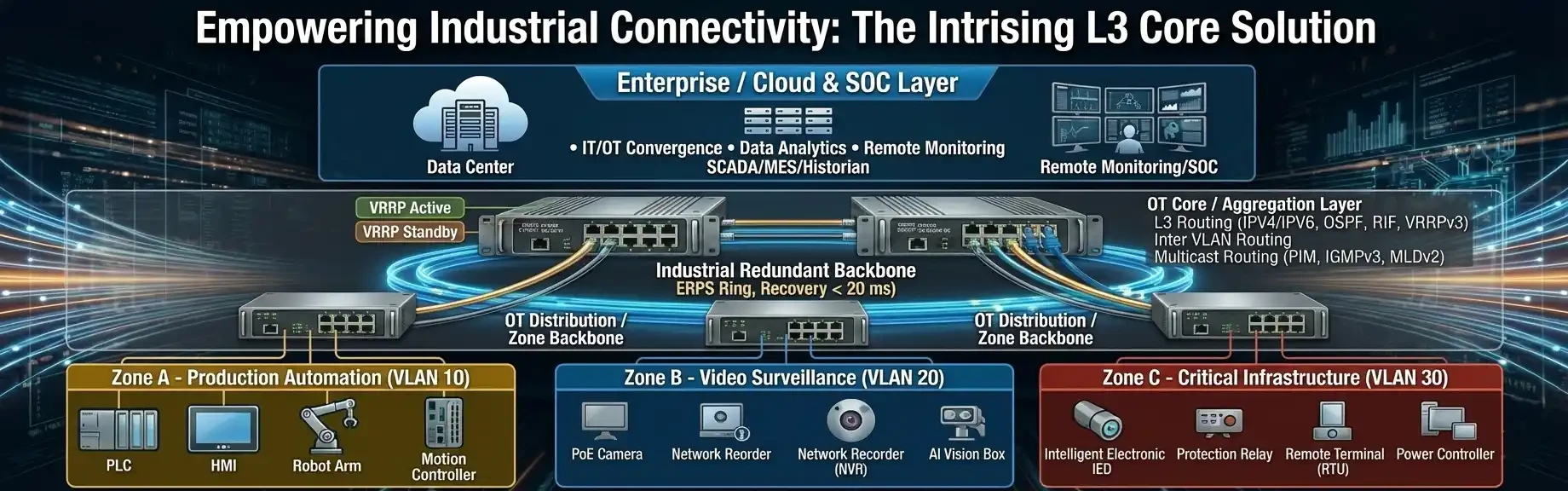
Intrising Layer 3 (L3) Core Solution is designed for industrial environments, bridging the gap between the shop floor and the enterprise layer. At its heart, the OT Core/Aggregation Layer utilizes L3 routing including IPv4/IPv6, OSPF, and Inter-VLAN routing to efficiently manage data traffic across different network segments. These core switches support high availability through VRRP (Virtual Router Redundancy Protocol), ensuring a seamless failover between active and standby units to prevent downtime.
The architecture in the picture is divided into logical security zones:
- Zone A (VLAN 10): Production automation including PLCs and robotics.
- Zone B (VLAN 20): Video surveillance and AI vision systems.
- Zone C (VLAN 30): Critical infrastructure like power controllers.
By implementing an Industrial Redundant Backbone with ERPS ring recovery in under 20ms, the system ensures robust, real-time connectivity. This L3 approach facilitates IT/OT convergence, allowing data from the ruggedized factory floor to reach the Data Center and SOC for advanced analytics and remote monitoring.
Recommended Products
-4X/imgs/poe_front__sm.webp)
DTS-8G(P)-4X
Industrial 8G+4x10G TSN Managed PoE Switch
-6X/imgs/poe_front__sm.webp)
DTS-16G(P)-6X
Industrial 16G+6x10G TSN Managed PoE Switch
-8M(P)-6X/imgs/poe_front__sm.webp)
DTS-8G(P)-8M(P)-6X
Industrial 8G+8x2.5G+6x10G TSN Managed PoE Switch
-4X/imgs/nopoe_front__sm.webp)
RTS-8G(P)-4X
Industrial 8G+4x10G TSN Managed PoE Switch
-8M(P)-6X/imgs/poe_front__sm.webp)
RTS-8G(P)-8M(P)-6X
Industrial 8G+8x2.5G+6x10G TSN Managed PoE Switch
-6X/imgs/poe_front__sm.webp)
RTS-16G(P)-6X
Industrial 16G+6x10G TSN Managed PoE Switch
-6X/imgs/poe_front__sm.webp)
RTS-24G(P)-6X
Industrial 24G+6x10G TSN Managed PoE Switch