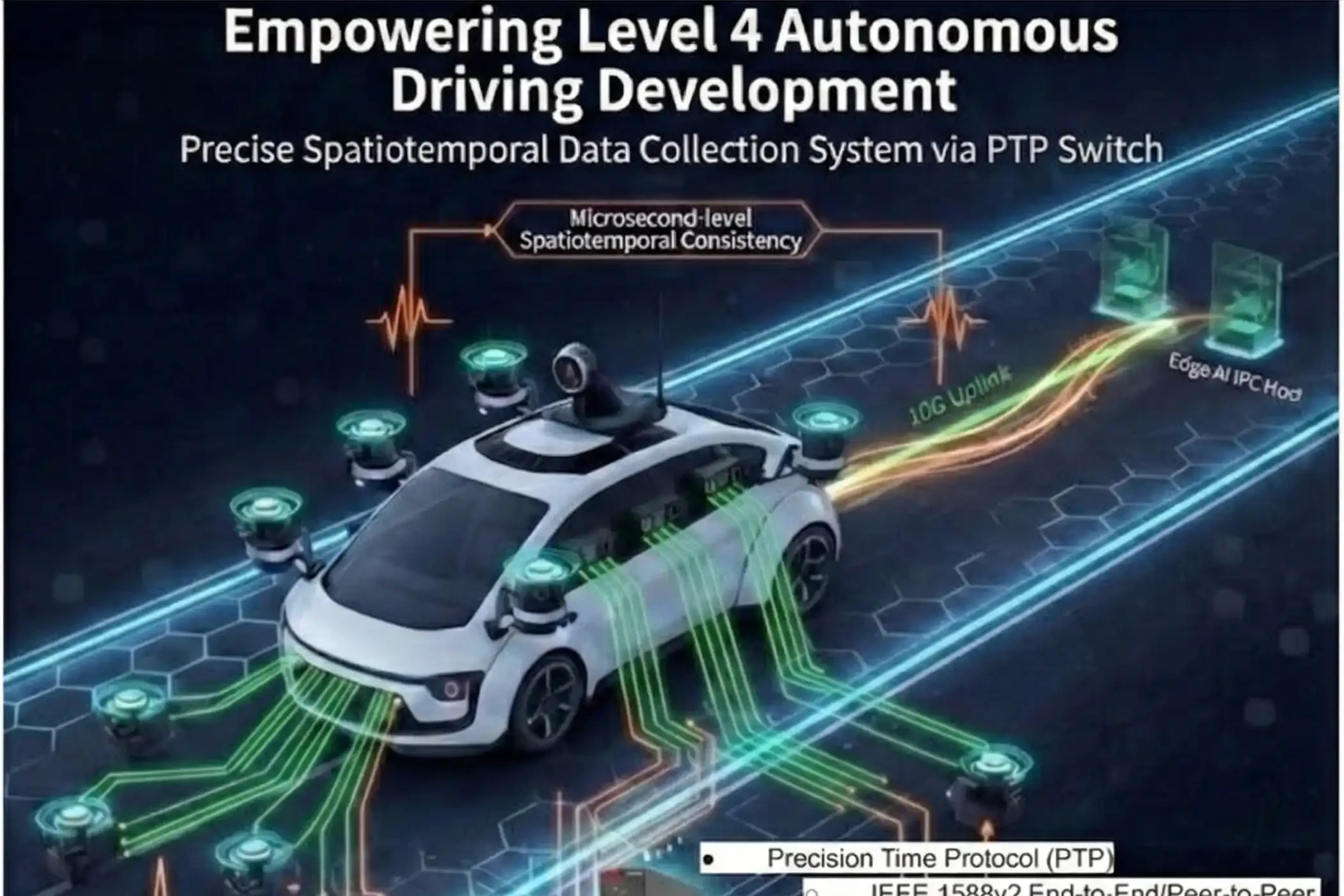
PTP Technology Enables Precise Autonomous Data
Intrising's 10G PTP switching solution serves as the critical synchronization backbone
| Location | Taipei |
|---|---|
| Industry | In-Vehicle Systems |
| Application | A Precise Spatiotemporal Data Collection System |
Case Background
The evolution of autonomous driving toward Level 4 autonomy has fundamentally changed the requirements for vehicle-to-everything (V2X) and internal sensor networking. High-quality, multi-sensor data collection is no longer just a benefit, it is the absolute foundation upon which reliable algorithm training and safety-critical decisions are built. In developing a next-generation data collection vehicle, the client encountered a significant hurdle known as the "Split Architecture" challenge. This complex setup required the seamless integration of five high-bandwidth LiDAR sensors and six high-resolution cameras into a unified, high-performance ecosystem.
The primary technical conflict arose from the disparate needs of these sensors. To maintain maximum data integrity and reduce processing overhead, the LiDAR point cloud data had to be transmitted directly to the Industrial PC (IPC). Conversely, the high-resolution camera feeds required routing through the network switch to reach the AI computing unit for real-time object detection and processing. This physical and logical separation of data paths threatened the system's "Spatiotemporal Consistency" the ability to ensure that every frame from every camera and every point cloud from every LiDAR is perfectly aligned on a universal timeline.
Without a sophisticated networking solution, the massive influx of image data would create severe bandwidth bottlenecks, leading to frame drops and synchronization drift. In the world of Level 4 autonomy, even a microsecond of misalignment between a camera's visual and a LiDAR's spatial data can result in inaccurate "ground truth" data, potentially compromising the training of the autonomous driving algorithms. The challenge, therefore, was to find a ruggedized, in-vehicle networking backbone capable of bridging these heterogeneous systems while maintaining microsecond-level precision across a complex, high-traffic split topology.
Requirements
- Microsecond Synchronization: The system must achieve sub-microsecond time alignment across all heterogeneous sensors to maintain spatiotemporal consistency.
- High Bandwidth Management: The architecture must support the real-time transmission of six camera feeds at approximately 4.8 Gbps without experiencing frame loss or latency.
- Hardware Robustness: Implementation requires an industrial-grade in-vehicle network backbone that provides PoE++ power and operates reliably in harsh environments.
Solution Provided by Us
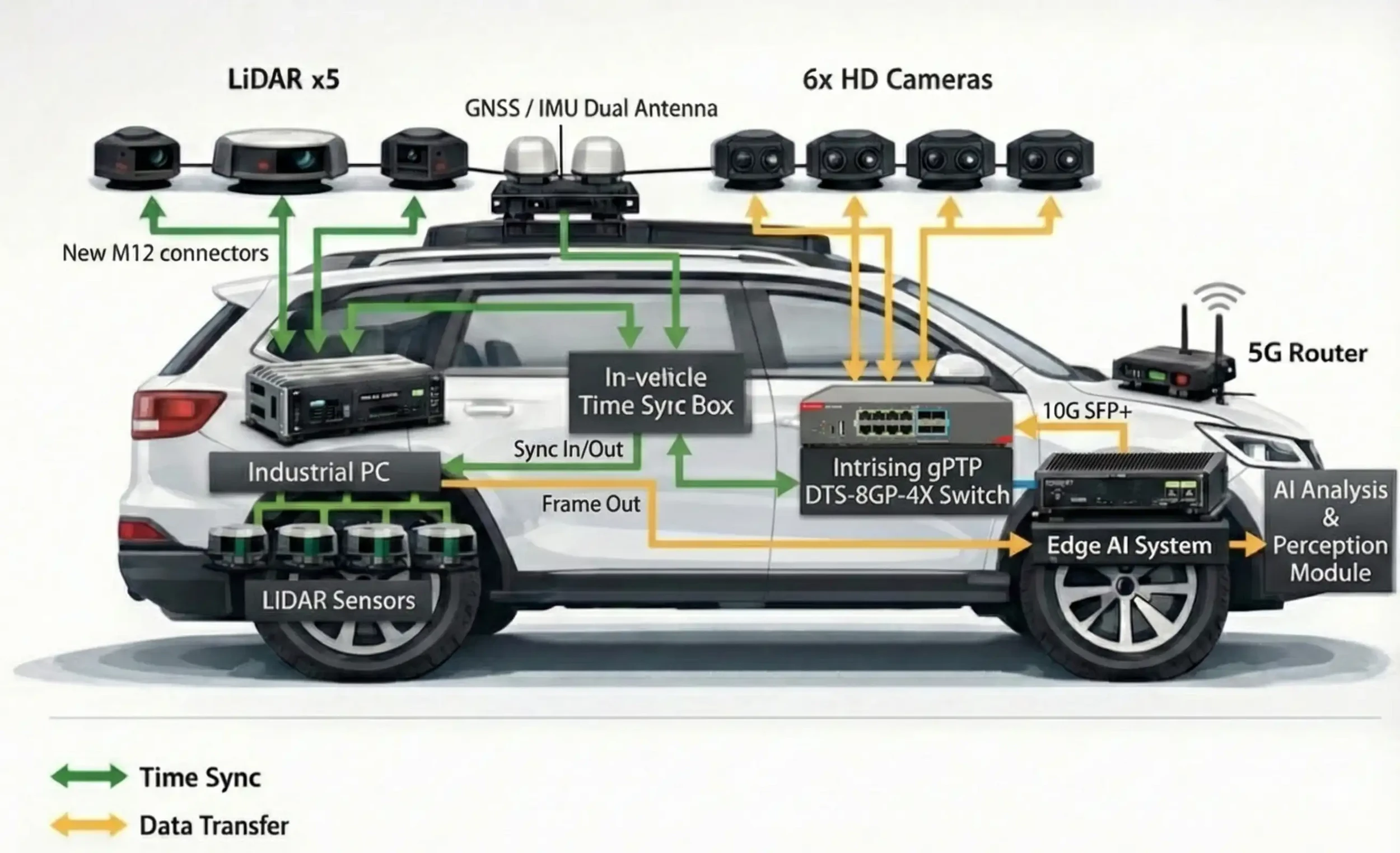
The implementation of the Intrising DTS-8GP-4X Industrial Managed Switch serves as the critical backbone for the vehicle's high-speed data network, facilitating seamless communication between the Time Sync Box, Edge AI System, and the Data Logging IPC. To solve the microsecond-level synchronization problem, the solution leverages IEEE 802.1AS (gPTP) Transparent Clock technology. In this configuration, an FPGA-based Time Sync Box acts as the Grandmaster clock, while the DTS-8GP-4X functions as a Transparent Clock (TC). As synchronization packets traverse the switch, the hardware precisely calculates and compensates for "residence time"—the internal processing delay within the switch—effectively eliminating variable network queuing jitters that usually degrade time accuracy.
Addressing the high-bandwidth requirements of the "Split Architecture," the solution adopts a sophisticated hybrid topology. The six high-resolution cameras, generating a combined 4.8 Gbps of traffic, are connected directly to the DTS-8GP-4X, which provides essential PoE++ power. These cameras are synchronized via physical hardware Frame Triggers from the Time Sync Box. Simultaneously, the five LiDAR units bypass the switch for data transmission, connecting directly to independent ports on the IPC to avoid congesting the primary camera network. However, their temporal alignment is maintained through PPS and NMEA physical signals.
To bridge these high-speed streams, the DTS-8GP-4X utilizes its 10G SFP+ uplink to deliver the aggregated 4.8 Gbps camera data losslessly to the Edge AI unit. On the recording end, the IPC synchronizes its internal system time via gPTP through the switch, ensuring every captured frame and point cloud is written to a high-speed NVMe SSD RAID array with perfectly aligned timestamps. This "Data Split, Sync Unified" strategy ensures that the LiDAR and camera data remain perfectly correlated on a single microsecond timeline for algorithm training.
Why Intrising DTS-8GP-4X
- 10G Uplink Capability: The 10G SFP+ ports prevent bottlenecks by handling 4.8 Gbps of camera traffic, which would overwhelm standard 1G uplinks.
- Precise gPTP Correction: As a Transparent Clock, it eliminates variable network latency, ensuring the Edge AI and IPC stay perfectly synchronized.
- High-Power PoE++ Support: It provides the necessary power and connectivity for multiple high-resolution sensors within a ruggedized, compact form factor.
-4X/imgs/poe_front__sm.webp)