
TSN: The Foundation of Unified Industrial Communication

gPTP Time Synchronization
Ensures the network shares a common time reference which is the foundation of deterministic communication
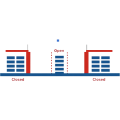
Time Aware Shaper
Pre-allocates bandwidth through a schedule, guaranteeing dedicated channels and minimum latency
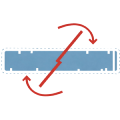
Frame Preemption
Allows high-priority short frames to interrupt long, low-priority frames, greatly reducing the transmission latency
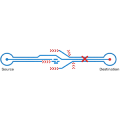
Frame Replication
Achieves Seamless Redundancy through packet duplication; data is not lost even if one path fails, ensuring high reliability
The evolution of Time-Sensitive Networking (TSN) was born from a critical fracture in traditional industrial communications: the lack of determinism. Standard Ethernet, while cost-effective and ubiquitous, operates on a best-effort delivery model. In a high-stakes factory environment, this unpredictability is a liability. When time-critical control data such as the signals telling a robotic arm exactly when to stop shares the same wire as high-bandwidth video surveillance or background diagnostics, network jitter occurs. Standard switches cannot prioritize these packets with microsecond precision, leading to data collisions and varying latencies.
Before TSN, manufacturers were forced to use fragmented, proprietary Fieldbus solutions to guarantee timing, creating isolated data silos that couldn't communicate with the broader enterprise. This lack of interoperability hindered the transition to Industry 4.0. TSN solves this by adding a layer of hard real-time synchronization and scheduled traffic shaping to standard Ethernet. By eliminating the interference between critical control loops and non-urgent data, TSN allows for a unified network architecture. This ensures that mission-critical packets always arrive at their destination precisely on schedule, regardless of other network traffic.

Our Solution
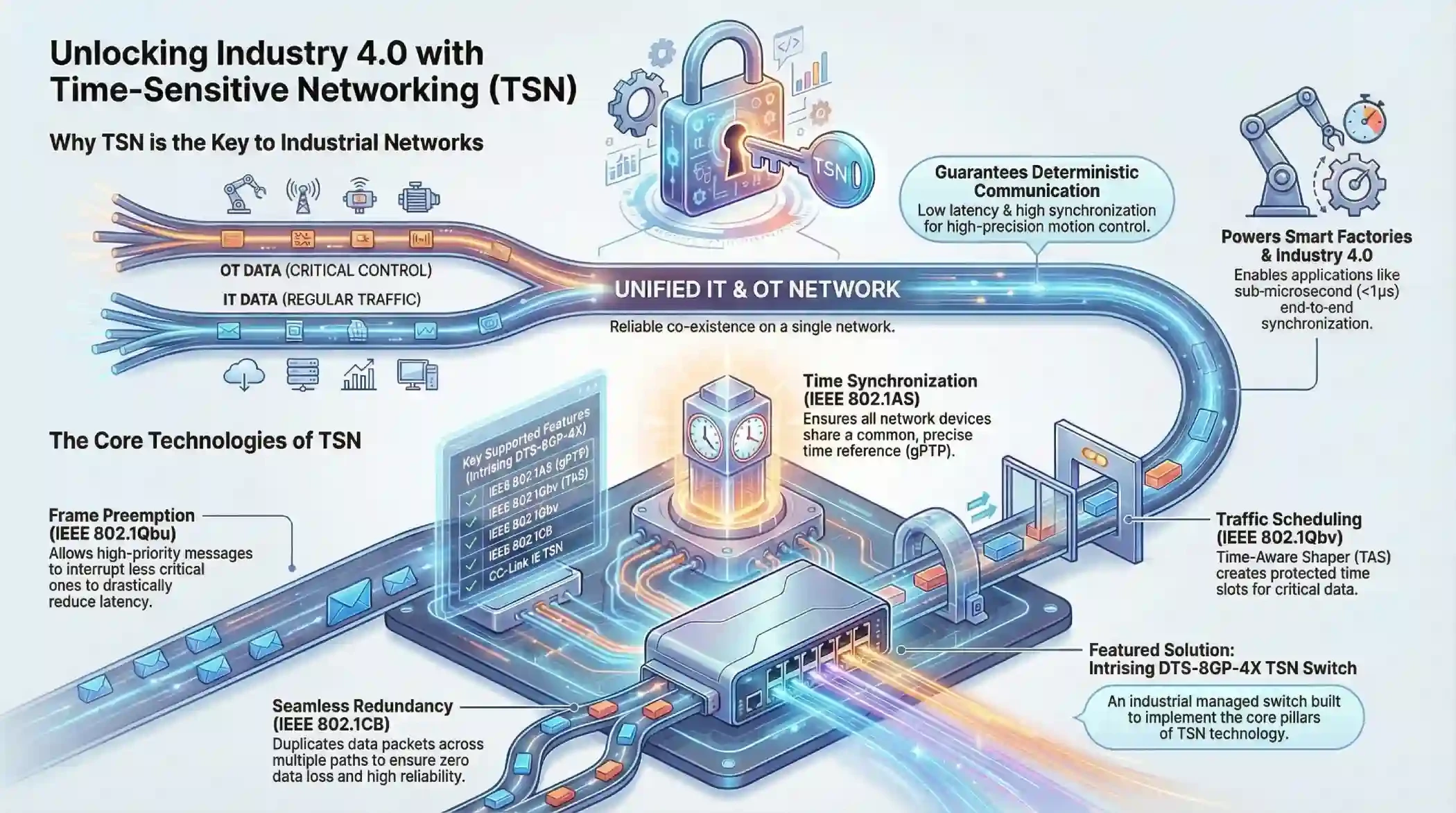
The provided diagram illustrates how Time-Sensitive Networking (TSN) bridges the gap between high-priority OT data and standard IT traffic on a single, unified network. This convergence addresses the best-effort limitations of standard Ethernet by implementing four core technical pillars. First, gTP Time Synchronization (IEEE 802.1AS) ensures all devices share a precise time reference, achieving sub-microsecond end-to-end synchronization. Second, Traffic Scheduling (IEEE 802.1Qbv) uses a Time-Aware Shaper to create protected time slots, guaranteeing mission-critical data never waits behind background traffic.
Furthermore, Frame Preemption (IEEE 802.1Qbu) allows urgent messages to interrupt less critical ones to reduce latency, while Seamless Redundancy (IEEE 802.1CB) duplicates packets across multiple paths to ensure zero data loss. By integrating these features into Intrising DTS-8GP-4X TSN Switch, industries achieve deterministic, high-precision motion control. This eliminates the cost and complexity of proprietary, isolated legacy systems, allowing for a truly scalable, interoperable, and future-proof industrial automation environment that supports real-time communication and high-bandwidth data analytics simultaneously across the entire factory floor.
Recommended Products
-4X/imgs/poe_front__sm.webp)
DTS-8G(P)-4X
Industrial 8G+4x10G TSN Managed PoE Switch
-6X/imgs/poe_front__sm.webp)
DTS-16G(P)-6X
Industrial 16G+6x10G TSN Managed PoE Switch
-8M(P)-6X/imgs/poe_front__sm.webp)
DTS-8G(P)-8M(P)-6X
Industrial 8G+8x2.5G+6x10G TSN Managed PoE Switch
-4X/imgs/nopoe_front__sm.webp)
RTS-8G(P)-4X
Industrial 8G+4x10G TSN Managed PoE Switch
-8M(P)-6X/imgs/poe_front__sm.webp)
RTS-8G(P)-8M(P)-6X
Industrial 8G+8x2.5G+6x10G TSN Managed PoE Switch
-6X/imgs/poe_front__sm.webp)
RTS-16G(P)-6X
Industrial 16G+6x10G TSN Managed PoE Switch
-6X/imgs/poe_front__sm.webp)
RTS-24G(P)-6X
Industrial 24G+6x10G TSN Managed PoE Switch