
Achieving Absolute Uptime with HSR/PRP

Zero Packet Loss
HSR/PRP ensures maximum reliability by transmitting duplicate data packets over independent paths

Zero Latency
HSR/PRP provides uninterrupted synchronization and real-time control for high-precision applications

Security MACSec
Protect your infrastructure with hardware-based MACsec encryption to ensure point-to-point data integrity

10G Uplink
Expand your network capacity with high-bandwidth 10G uplinks to eliminate bottlenecks for data-heavy traffic
In the high stakes world of industrial automation, standard Ethernet protocols originally designed for office environments proved inadequate for mission critical operations. The primary technical hurdle was convergence time, the delay required for a network to reroute data after a link or node failure. Traditional redundancy protocols, such as Spanning Tree Protocol (STP) and even its Rapid variant (RSTP), operate reactively; they detect a break and then reconfigure the path. This reactive nature creates a period of network silence while the topology resets.
In a high-speed manufacturing line or a power substation, a recovery delay of even a few milliseconds can be catastrophic. Such micro-blackouts in data transmission can trigger emergency equipment shutdowns, cause synchronized robotic arms to lose timing, or lead to massive financial losses due to production downtime. This vulnerability necessitated a proactive rather than reactive approach. Consequently, High-availability Seamless Redundancy (HSR) and Parallel Redundancy Protocol (PRP) were engineered to provide bumpless recovery. By sending duplicate data packets over two independent paths simultaneously, these protocols ensure that if one path fails, the destination still receives the data from the other without a single millisecond of interruption.

Our Solution
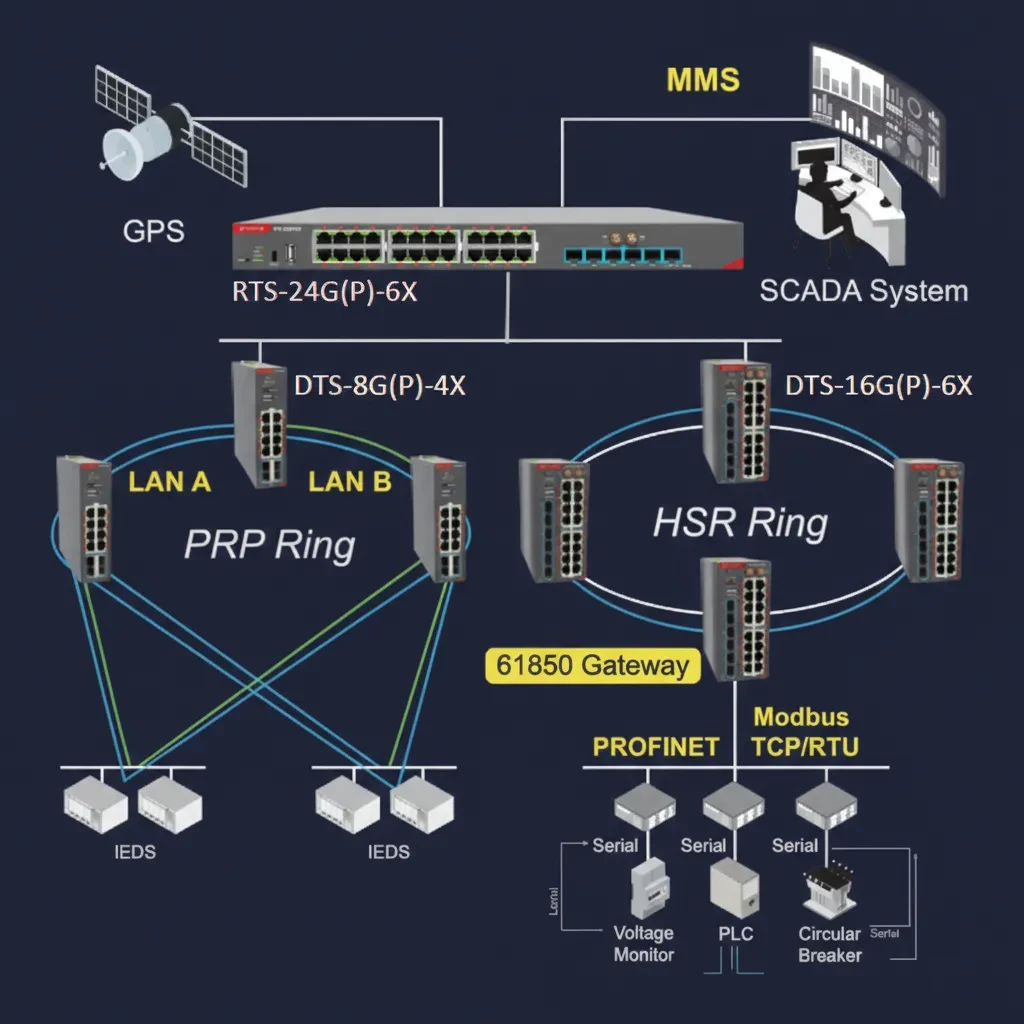
Industrial Ethernet switches equipped with High-availability Seamless Redundancy (HSR) and Parallel Redundancy Protocol (PRP) directly address the dangerous convergence delays inherent in standard protocols. While traditional methods react to a failure by rerouting traffic causing millisecond-long gaps HSR and PRP operate on a zero-recovery-time principle. By sending duplicate packets over two independent paths simultaneously, these switches ensure that if one link or node fails, the destination still receives the data from the alternative path without any interruption.
This active redundancy eliminates the risk of packet storms or blackout periods during a network fault. For mission-critical infrastructure like smart grids or high-speed robotic assembly, this means operations continue seamlessly. These technologies transform the network from a reactive system into a proactive, bumpless foundation, effectively preventing the emergency shutdowns and equipment damage that occur when even a single millisecond of data is lost.
Recommended Products
-4X/imgs/poe_front__sm.webp)
DTS-8G(P)-4X
Industrial 8G+4x10G TSN Managed PoE Switch
-6X/imgs/poe_front__sm.webp)
DTS-16G(P)-6X
Industrial 16G+6x10G TSN Managed PoE Switch
-8M(P)-6X/imgs/poe_front__sm.webp)
DTS-8G(P)-8M(P)-6X
Industrial 8G+8x2.5G+6x10G TSN Managed PoE Switch
-4X/imgs/nopoe_front__sm.webp)
RTS-8G(P)-4X
Industrial 8G+4x10G TSN Managed PoE Switch
-8M(P)-6X/imgs/poe_front__sm.webp)
RTS-8G(P)-8M(P)-6X
Industrial 8G+8x2.5G+6x10G TSN Managed PoE Switch
-6X/imgs/poe_front__sm.webp)
RTS-16G(P)-6X
Industrial 16G+6x10G TSN Managed PoE Switch
-6X/imgs/poe_front__sm.webp)
RTS-24G(P)-6X
Industrial 24G+6x10G TSN Managed PoE Switch