How Redbox HSR/PRP Eliminates Industrial Network Reconvergence Delays

MACsec (IEEE 802.1AE)
Provides carrier-grade data encryption
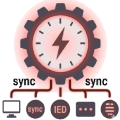
IEEE 1588v2 PTP
Ensures precise time synchronization across the entire system
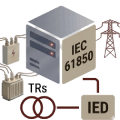
Built-in IEC 61850 MMS Server
Facilitates integration with substation automation systems
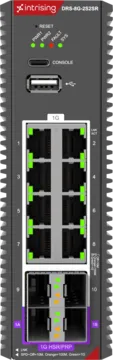
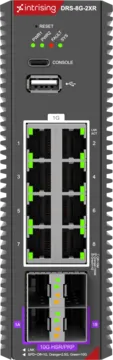
Hardware-Accelerated HSR/PRP
Provides 10G-level processing throughput
Before the advent of High-availability Seamless Redundancy (HSR) and Parallel Redundancy Protocol (PRP), industrial networks particularly in power substations struggled with the "reconvergence delay." Traditional recovery protocols, such as Spanning Tree Protocol (STP) or Rapid Spanning Tree Protocol (RSTP), were designed for IT environments where a few seconds of downtime was acceptable.
In critical infrastructure, however, even a millisecond-scale interruption could be catastrophic. If a network link failed, these older protocols had to detect the break, recalculate a new path, and reconfigure the traffic flow. During this "healing" period, data packets were lost. For time-critical applications like Generic Object Oriented Substation Events (GOOSE) messages or Sampled Values, this data loss meant protection relays might fail to trip during a fault, leading to massive equipment damage or widespread blackouts. Consequently, industries faced a binary struggle: accept the risk of packet loss during failures or invest in complex, proprietary, and expensive hardware solutions that lacked interoperability. The "RedBox" (redundancy box) solved this by enabling zero-recovery-time communication using standard Ethernet.

Our Solution
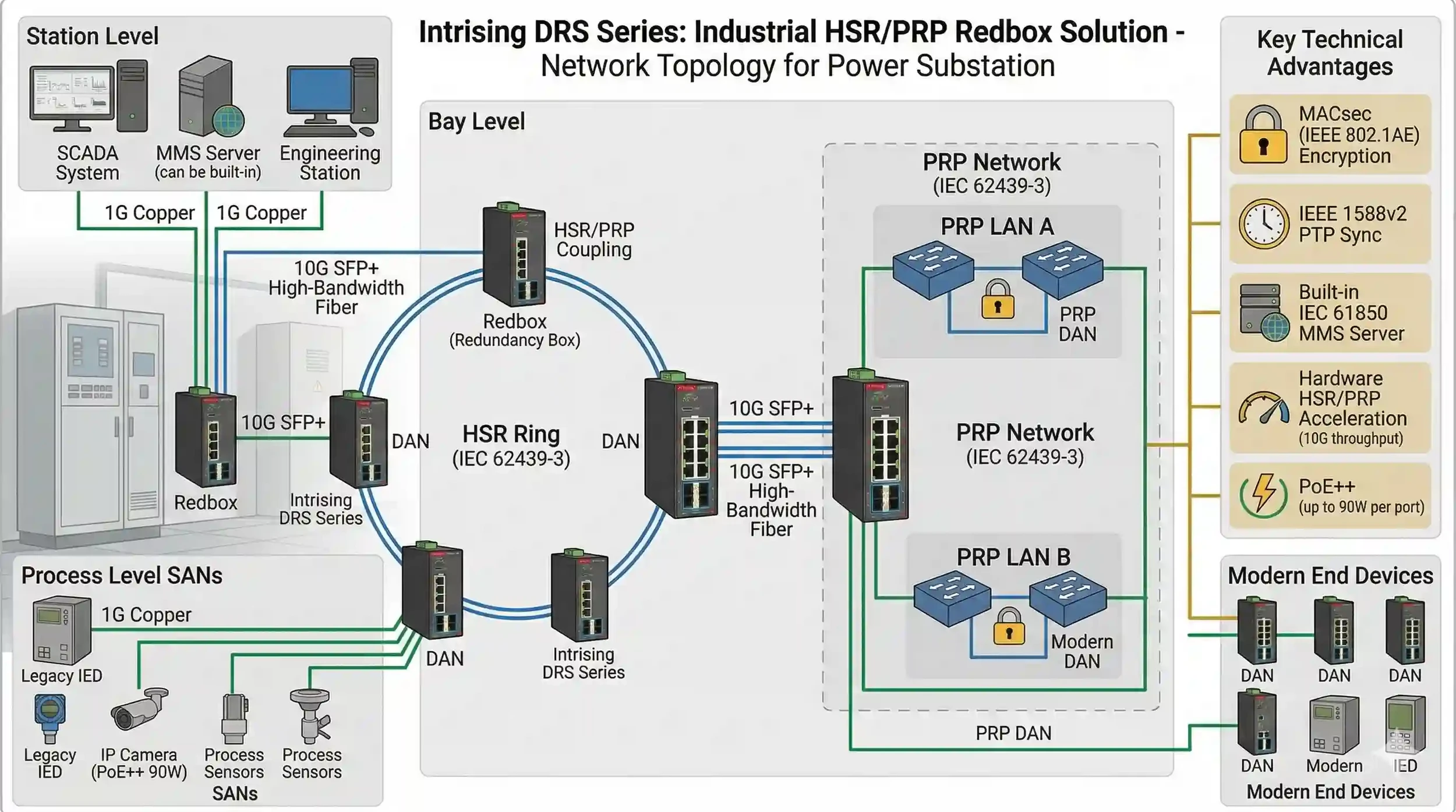
This illustrates how the Redbox (Redundancy Box) acts as the vital bridge between legacy infrastructure and modern, ultra-reliable networks. As discussed, the primary issue was "reconvergence delay" where networks went dark during failures. The Redbox eliminates this by serving as an entry point for Singly Attached Nodes (SANs) such as the legacy IEDs and IP cameras shown at the Process Level into a "zero-recovery-time" environment. By integrating these older devices into an HSR Ring or PRP Network, the Redbox duplicates every outgoing data packet.
In the HSR ring topology shown, it sends frames in both directions simultaneously; if one fiber path is severed, the duplicate frame arriving from the opposite direction ensures the SCADA system never loses a beat. There is no "recalculation" period because the backup data is already in transit. Furthermore, the diagram highlights Hardware Acceleration, ensuring that this heavy duplication happens at 10G speeds without adding latency, effectively future-proofing critical substation operations against the catastrophic data gaps of the past.